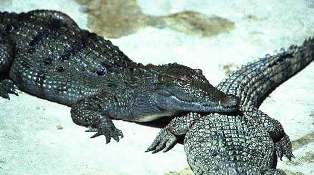
Philippine crocodile. (Photo by F. Wayne King. 穢 1996
. Used with permission.)
The , a Philippine NGO funded by , recently released 50 captive-bred Philippine crocodiles���a species listed as critically endangered on the and often considered the most critically imperiled of any crocodile���into Dicatian Lake in Isabela Province in northern Philippines.
Ten of these reptiles received radio transmitter collars so scientists from the Mabuwaya Foundation and the Department of Environment and Natural Resources can track their movement and behavior.
These three-meter-long crocs endemic to the Philippines used to be widely distributed; today, the Mabuwaya Foundation (formerly called the Crocodile Rehabilitation, Observance & Conservation or CROC Project) puts the number of non-hatchling adults at or around 100, all of which reside in three areas. They���ve been on the since the mid-1970s and the IUCN Red List since the mid-1990s.
Hunting used to account for the majority of population decline, according to the IUCN���s . Today, however, habitat depletion plays an equal���or larger���role.
Dicatian Lake, officially dubbed a crocodile sanctuary by the local government, is now home to the world���s single largest population of Philippine crocodiles. The IUCN calls the release of these 50 crocs ���a major step towards a recovery of the wild population and the future survival of this species.��� What do you think?
Note: To learn more about this and other species of crocodiles, check out the Crocodile Specialist Group���s and pages.


